Essay 1 - 2024
Kunstenaarschap als beroep?
Welnee. Het is de belichaming van het leven.
Als men vraagt wat voor soort baan ik met mijn studie krijg, is de meest logische optie natuurlijk 'kunstenaar'.
Kunstenaarschap is naar mijn mening de manifestatie van het leven: documentatie, vernieuwing, cultuur, emoties, ervaringen, alles wat de rijke werkelijkheid doorgeeft. Maar ik zie dat niet als baan. Een baan is immers een contract tussen persoon en arbeidsinstantie. In mijn visie is de relatie met het kunstenaarschap een beminnende relatie, geen contractuele. Het is de relatie die je kiest ondanks de betere, stabielere opties. Waar je het liefst je tijd mee doorbrengt, ook al vraagt het meer geld, tijd en energie dan het je oplevert. Maar wij kunstenaars creëren de belichaming van het leven.
Zo'n lichaam is een complex omhulsel waarin de ziel wordt gewaarborgd, geschapen, gevormd en verdwijnt, een omhulsel waar veel ervaringen zich in bewegen.
Vanuit The Carrier Bag Theory Of Fiction zou men spreken over de kunstenaar als een net, een mand, of beter gezegd: de baarmoeder en tombe waar leven gecreëerd en beëindigd wordt. Wij kunstenaars nemen de reproducerende Sisyfusarbeid van het leven op ons. Ook al zouden anderen spreken over de nutteloosheid van deze eindeloze productie van alles wat bij het leven hoort, wij rollen onze kei toch wel weer omhoog, en terwijl we dat doen leven we als geen ander.
Sisyphus hield zo van het leven dat hij zijn straf kreeg omdat hij de dood wist te ontsnappen en daardoor de goden bedroog. De goden wilden hem straffen door hem een onmogelijke en nutteloze taak op te leggen. Maar waar men tegen mij of Sisyphus zegt dat het toch geen impact maakt of iets verandert, zijn wij bezig ons lot te overwinnen zodat het ons niet deert. We blijven rollen.
De Finse kunstenaar Pilvi Takala speelt met thema's als absurditeit en doelloosheid in The Trainee, waarin zij een maand bij Deloitte heeft gewerkt. De meeste mensen waren in het ongewisse over de echte reden dat Takala de hele dag voor zich uit zat te staren in de bieb. Ze deed de hele dag niets, ook niet op haar mobiel staren, nee, echt niets. Op een gegeven moment stond ze de hele dag in de lift zonder doel of bestemming. Dit vonden collega's vaak ongemakkelijk of ondraaglijk. Ze waren constant bezig met klachten indienen of oplossingen bedenken voor het 'vreemde' gedrag van hun nieuwe werknemer.
Dit werk bewonder ik om de elementen van absurditeit en het bevragen van maatschappelijke normen. De mensen om haar heen zouden er amper iets van hebben gemerkt als ze gewoon een boek las of stiekem zat te gamen. Ze breekt de illusie van onze samenleving, die vaak gebaseerd is op allerlei onnozele sociale constructen. In een wereld vol schadelijke en onnodige tradities, overtuigingen en gebruiken over wat het leven is en moet zijn, creëer ik mijn eigen waarden, net zoals Sisyphus zijn waarde vond in de eindeloze tochten die hij maakte.
Gelukkig hoef ik niet elke keer dezelfde steen over dezelfde berg te duwen, en ik zie het ook niet als een lineair proces dat telkens opnieuw begint. Mijn taak valt meer onder het systeem van The Carrier Bag Theory Of Fiction: het dragen van stenen, ofwel allerlei aspecten uit het leven, in mijn draagzak. Men kan ze uitwisselen, beschilderen, vormgeven, keilen over het water, uitvindingen mee doen, onrechtvaardige machtsfiguren van hun troon proberen af te werpen en alles wat je maar kan bedenken, totdat ik zelf een paar meter onder een steen lig.
De keuze is eindeloos en rijk. Precies daarom is mijn keuze als toekomstige partner van de belichaming van het leven, of het nu in een studio is, als hybride praktijk, adviseur of change-agent, slechts afhankelijk van welke stenen ik tegenkom, welke me inspireren of ontroeren, en welke draagbaar zijn voor mijn lichaam.
Essay 2 - 2023
In koppeling met Immanuel Kant en George Bataille.
Van alle denkers die we hebben besproken in de lessen, zie ik de meeste raakvlakken met George Bataille in mijn werk, maar ook Immanuel Kant heeft punten die van belang zijn voor mijn kunstpraktijk.
Mijn werk voldoet slechts deels aan de criteria van esthetisch objectivisme en valt eerder onder het sublieme. Het sublieme staat naast het mooie, dat harmonieus en geordend is, en het aangename.
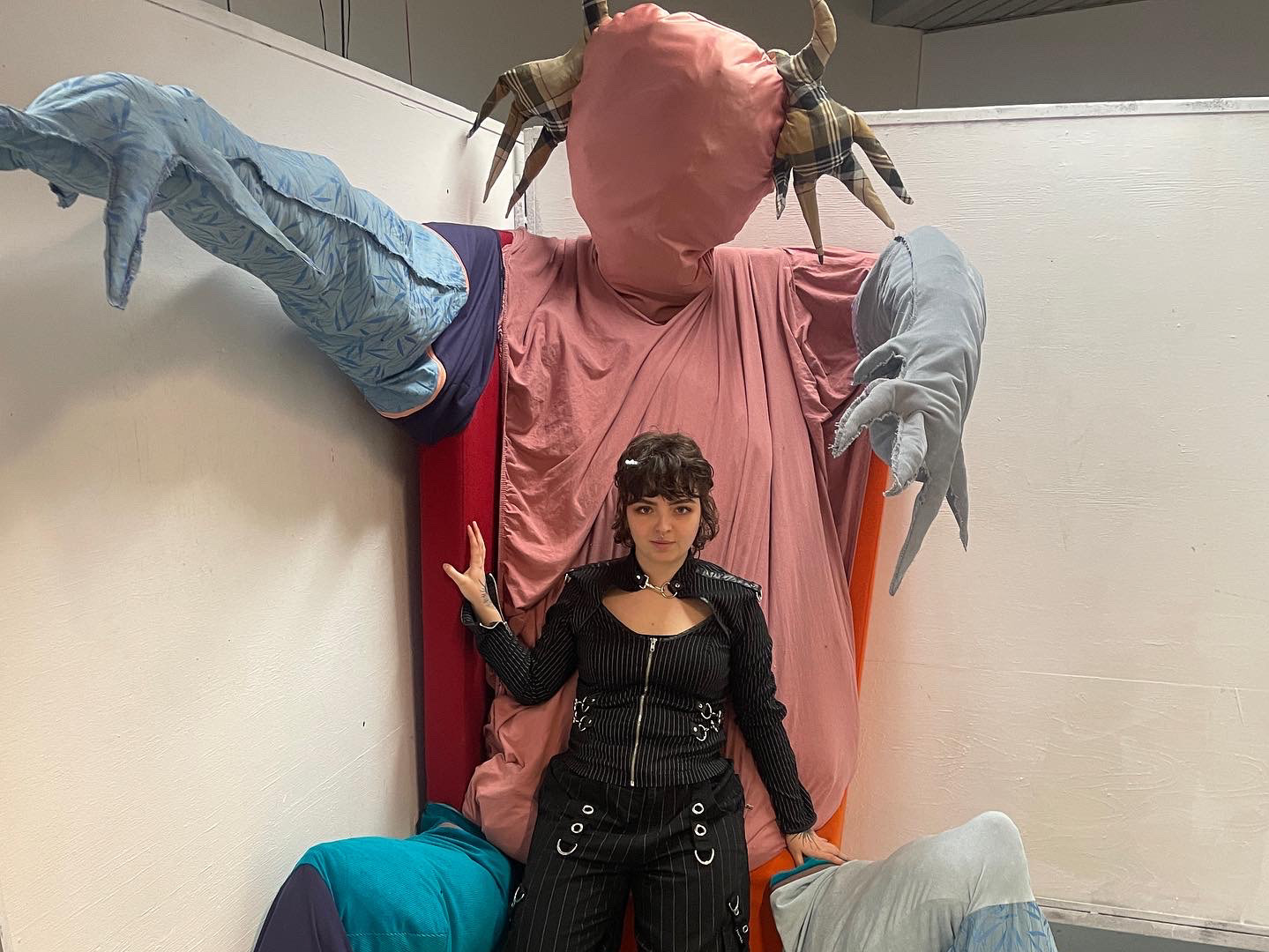
In Kritiek van het oordeelsvermogen onderscheidt Kant het aangename, het mooie en het sublieme. Het sublieme wordt gekenmerkt door een gevoel van overweldigendheid, terreur en ontzag. Mijn monster, gepositioneerd in een bedreigende houding met klauwen die je willen pakken, sluit daarbij aan: het roept terreur en overweldiging op. Het sublieme, dat bij Kant verschijnt als een diepe klif, een razende orkaan of een uitstrekkende oceaan, bevat een aspect van genot dat de mens verkrijgt door zich superieur te voelen aan het sublieme verschijnsel. Het weten te relativeren van het grandioze sensorische ervaring, zonder je erdoor te laten overweldigen. Ik vind dit een ironische link met mijn eigen werk, dat de superioriteitshouding van de mens boven de natuur belicht en de nonchalance tegenover de grandiositeit van het sublieme, zoals plastic soep of bergen afgedankte kleding in Ghana, binnen de fast-fashioncyclus.
Kant maakt echter een duidelijk onderscheid tussen het morele goede, het praktisch nut en het esthetische smaakoordeel. Hij stelt dat esthetica autonoom is en dat een oordeel over schoonheid waarin ook maar een beetje belang meespeelt, partijdig is en geen zuiver smaakoordeel. Bij mijn werk is het gebruik van ethisch verkregen materiaal, dat milieuvervuiling tegengaat in plaats van veroorzaakt, een groot deel van het concept en de vormgeving. Dat betekent dat het werk elementen van moraliteit en praktisch nut bevat, die ook meespelen in het oordeel over het werk. Ook het idee van doelmatigheid zonder doel is tegenstrijdig met mijn project, dat grotendeels leunt op het idee van niet-afbreekbaar textiel opslaan in sculpturen om te voorkomen dat het op afvalbergen of versnipperd in de oceaan terechtkomt. Een moreel en praktisch doel dus.
Dit brengt mij tot de vraag of mijn kunstwerk kunst is in zijn volledigheid, of alleen de vormgeving ervan. In principe zou je afgedankt textiel ook kunnen gebruiken als isolatiemateriaal of als vulling voor kussens, en dan zou niemand het als kunst beschouwen. Uiteindelijk neig ik ernaar dat kunst ook beoordeeld mag worden aan de hand van belangen zoals moraliteit en functie, als dat onderdelen van het werk zijn, en dat dit een werk mooier kan maken, zowel in concept als esthetica. De schoonheid kan misschien apart worden beoordeeld puur op esthetische gronden, maar het totale oordeel vergt voor mij ook het meewegen van ethiek en nut, als die onderdelen zijn van het werk.
Als tweede denker sloten de interesses van George Bataille duidelijk aan bij dit werk: obsceniteit in de vorm van een misvormd monster dat zich niet houdt aan het conventionele beeld van schoonheid. Het exposeren van het weerzinwekkende, door een monster te plaatsen dat je aankijkt met opengereten buik en mond en schrikbarend een confrontatie eist, kan worden gezien als een act van transgressie tegenover de nietsvermoedende bezoeker.
Waar Bataille het duistere en wellicht onethische in de mens omhelst vanuit een anti-humanistische blik, en dit wil belichten uit interesse in een wereld waar netheid de norm is, doe ik dat weliswaar ook vanuit een anti-humanistische blik, maar met een gevoel van plichtsbesef en realistisch pessimisme in een wereld waar gierigheid en laksheid de norm zijn. Met name op het gebied van duisterheid en de ethiek van kunst verschillen onze standpunten.
Het profane, wat Bataille eveneens bespreekt, zie ik in mijn project in de houding van consumenten en modebedrijven die zo min mogelijk energie willen steken in controles bij fabrikanten, het verbeteren van werkomstandigheden, het vervangen van schadelijke materialen, of in kopers die telkens weer fast fashion kopen omdat het sociaal geaccepteerd is.
Essay 3
Shedding a Marxist light on the anime “Shadows House.”
Introduction
Escaping the workings, damage, dehumanisation and ideals formed by capitalism is hard, even as an aspiring Marxist. Just like when I was watching Shadows House (2021–2022) based on the manga by duo Somato[1], I started romanticizing the work ethic of the living dolls (maids and cleaners) in the anime.
I realised this thinking pattern creeping inside me when the next scenes woke me up. The revelation of the dolls’ mistreatment led me to question how I even could romanticise their work ethic in the first place. However, looking at the world filling us with a dominant ideology that places more value on wealth than welfare, it starts to make sense. To fight against this given reality, I try to arm myself with knowledge and to find solidarity with other communists.
Capitalist hegemony and its supporting structures are easily promoted through culture and media. Communism on the other hand, lacks the compelling attractiveness, and graspable visuals perhaps caused by this stale, complex and factual Marxist way of perceiving the world. For example, my field trip[2] about workers exploitation in Oss, was quite boring and lacked visual support to tell an engaging story.
Which is why this essay, combined with the anime, functions as a visual explanation for otherwise boring and hard to grasp Marxists theories. Although the anime lacks the explicit mention of communist theory, an essay combined with this storytelling animation could bridge the gap. It could help enlighten regular people living in the shadows of capitalism, who didn’t yet realise they’re allowed to feel the warmth of the sun.
Marxist theory
Because of the depth and broadness of Marxist writings and all suitable allegories found in Shadows House, I decided to limit the theories, terms and thinkers to the following.
Surplus Value: A fast way to make a profit as a capitalist is by extracting the surplus value of labour. When labour is turned into a commodity, the prize capitalists pay for the value of labour, is less than the value of labour given to the production process. This results in a difference that turns into profit for the capitalists.
Or as described by Karl Marx; “Surplus value is nothing but the excess amount of labour the worker gives over, above the amount of materialized labour that he receives in his own wages as the value of his labour power”.[3]
Or as described by Karl Marx; “Surplus value is nothing but the excess amount of labour the worker gives over, above the amount of materialized labour that he receives in his own wages as the value of his labour power”.[3]
Alienation means that the more a worker produces, the more capitalists gain. Their power over the proletariat enhances, more competition amongst workers rises, the misery of mind-numbing work increases, and more objectification and regulation of the commodified workers occurs.
In the process, the commodified workers and their commodified labour get devalued more. Therefore, the products of their labour, become hostile and alien from themselves and their labour. As stated by Karl Marx:
“For on this premise it is clear that the more the worker spends himself, the more powerful becomes the alien world of objects which he creates over and against himself, the poorer he himself – his inner world – becomes, the less belongs to him as his own.”[4]
Class consciousness and its antithesis false consciousness[5] means the proletariat becomes aware of this very undervalued and exploited position. This awareness is often the first step to revolt against capitalism. False consciousness is of course the opposite and keeps workers distracted, docile or self-sacrificing. This happens through factors like religion, as I was told on my field trip about the local factory owner hiring catholic priests to ‘guide’ workers into obedient god-fearing labourers. Though Marx did not come up with the term “class consciousness” but stated in one of his letters: “The ordinary English worker hates the Irish worker as a competitor who lowers his standard of life. In relation to the Irish worker he regards himself as a member of the ruling nation and consequently he becomes a tool of the English aristocrats and capitalists against Ireland, thus strengthening their domination over himself.” [6]
Marx’s ideas later sparked theories of Marxist thinkers George Lukazc and Antonio Gramsci who both specified and contributed to this phenomenon of workers reproducing ideology that is against their own interest. Gramsci, while imprisoned in fascist Italy, could not solely explain the hegemonic perceptions, morals and values through economics or politics.[7]
This Marxist concept suggests that the proletariat does not recognise their exploitation by the bourgeoisie and therefore contributes to their own exploitation because their whole worldview and culture is built to support it. The concept called cultural hegemony, contributed to Antonio Gramsci, is a perfect way to prevent class solidarity.
Working class solidarity to Marxists, means the unification of all exploited people from the proletariat. This can result in organised actions that hurt the pockets and the very fundament of the capitalists.[8]
Shadows House
“Let it never be forgotten that the shadows are an amazing family of nobles. It is every living doll’s greatest pleasure to serve them.”
A group of young children mindlessly drones on this sentence as they finished drinking coffee. In this anime, the children picked out for service at the prestigious Shadows House are now called living dolls. They try to find their footing in the mysterious shadows house. Paired with their aristocratic masters, they clean soot all day and act as a visual proxy for their faceless shadow’s expressions, hence the dolls are also called faces. But when the brainwashing of the coffee stops working, this group of young dolls, along with their masters are starting to question and uncover the true workings of the shadows house. And of course, this endeavour works better with everyone united instead of divided, as this group of young shadows and living dolls challenge the roles given to them by Shadows House.
Analysis
Soot[9] and surplus value
When shadows experience negative emotions, they emit soot that soils the interior of shadows house. Soot is also their power, that’s being judged on soot volume and usefulness. The volume is important because the shadows house biggest export product is their soot coal. Half of the living dolls tasks is to clean the soot in their master’s room plus every inch of the children’s wing. Aside from getting necessities like food, they’re not being paid for this tiring, dangerous work. If neglected, soot will clutter and turn into scorches that cause soot sickness. I think this illustrates the dangerous conditions of labour, and even the notion that concentrated power will wreak havoc and take lives of those without power. Namely, soot sickness can kill living dolls. The soot that gets cleaned and gathered is exported for profit. This surplus value of the soot was created by living dolls’ labour, tiredly gathering and cleaning soot. All while not paying these workers a cent. Profits are used for expansion of the shadows houses power and buying labourers (living dolls) who then in time get tasked with cleaning soot. Repeating the cycle of getting their surplus value extracted through the exploitation of labour power.
When shadows experience negative emotions, they emit soot that soils the interior of shadows house. Soot is also their power, that’s being judged on soot volume and usefulness. The volume is important because the shadows house biggest export product is their soot coal. Half of the living dolls tasks is to clean the soot in their master’s room plus every inch of the children’s wing. Aside from getting necessities like food, they’re not being paid for this tiring, dangerous work. If neglected, soot will clutter and turn into scorches that cause soot sickness. I think this illustrates the dangerous conditions of labour, and even the notion that concentrated power will wreak havoc and take lives of those without power. Namely, soot sickness can kill living dolls. The soot that gets cleaned and gathered is exported for profit. This surplus value of the soot was created by living dolls’ labour, tiredly gathering and cleaning soot. All while not paying these workers a cent. Profits are used for expansion of the shadows houses power and buying labourers (living dolls) who then in time get tasked with cleaning soot. Repeating the cycle of getting their surplus value extracted through the exploitation of labour power.
Shadows, their living dolls and their consciousness.
The shadows, wealthy soot covered figures, depend entirely on the labour of their living dolls. Young shadows strive to climb up the ranks in the mysterious shadows house. To achieve greatness, they need to control their dolls so they can become excellent faces, and when they fail, they both get discarded. But when they succeed, promising young shadows will go through ceremonies that grant them privileges. Successful shadows are invited to a final fusion ceremony, where only the most promising shadows and their faces get invited to.
This dynamic mirrors Karl Marx’s theory of alienation, where workers under capitalism are estranged from their labour, their own humanity, and each other. Like proletarians trapped in a system that extracts their labour while rendering them expendable, the dolls’ existence is reduced to mechanical service: they wake up to clean soot, mimic their masters’ behaviours, get discarded if deemed defective. The second season’s climax, when a shadow and their living doll is invited to the fusion ceremony, reveals the dolls very existence gets usurped by their master and thus losing their consciousness. The only thing that remains is their face, now available to be used by their shadows. To appear human for recruiting new living dolls for example. This ultimate shock exposes the Shadow House’s true function: a system of exploitation that alienates the workers to the extent of non-existence to sustain ruling-class power.
Emilico, a living doll, wakes up in a box and automatically serves her master, a shadow called Kate. Other than their attire and the lack of a face on Kate, there are big differences between them. While Emilico repetitively cleans soot, Kate lives in luxury and spends her time in her room reading the shadow book called “The Shadows Family’s Teachings”[10] while honing her soot powers.
Before their first ceremony, a milestone in the development of the shadow, it’s up to the shadow to read and execute the ideologies in the book to get more status and privileges such as leaving their room. The book contains the following information.
“The Shadows House is a wonderful family of noblemen who are loved by the people. Let us be prideful as an aristocrat of the Shadows Family.
“Living Dolls” are your tools, who will take care of you and act as your “face.”
Let us master using our “living dolls.” This is also connected to raising your personal value as well.
Shadows who haven’t passed the “Debut” can’t leave their rooms of their own volition.
Shadows name the “living dolls.” A “living doll’s” name does not matter. Therefore, let us give them a name that is easy to remember. For example… your nickname, something close to your name, or something simple.
“Scorches”: Malicious lumps that come from soot. They occur when cleaning is neglected.”
These cultural hegemonic statements set the stage for the rules and status quo, presented as natural. Just like the mottos for living dolls “Do not fret over trivial matters”, and “Let it never be forgotten that the shadows are an amazing family of nobles. It is every living doll’s greatest pleasure to serve them”.
These manners of supressing and misleading the workers and their masters, resemble the way cultural hegemony operates. Namely creating a false consciousness of literally believing you are a doll and not a person, only existing to serve the shadows house. These believes are spread through education and ideology. It gets presented, not just by the ruling class, but also reproduced and believed by the working class themselves, as spoken about by Marxist Antonio Gramsci.
Although Emilico and Kate started off with some emotional distance, Kate names Emilico after a character from a book, resembling her cheerful personality. Kate shows she cares about Emilico’s identity, separate from her. This is the beginning of Kate and Emilico prioritising human relations instead of objectification of workers.
The duo grows closer to a few shadows and their faces in the children’s wing to acquire more knowledge. Later, this group decides to support each other and to find out the truth of shadows, Shadows House and the actual identity of the living dolls. On their journey, class solidarity arises, for example when Emilico and another living doll Shaun, stand up for living doll Rum that got falsely accused of not cleaning. They later share punishment that otherwise might have ruined the timid Rum. Sadly, Rum and her master Shirley get disposed after they fail the initial ceremony, displaying the cruelty of the house. Yet Emilico, brainwashed again by the soot coffee, can only feel happy about it. Kate searches desperately in Emilico’s diary that talks about curing soot sickness, and Kate applies this method to cure Emilico from brainwashing. After the incident then the group finds out that the living dolls are humans tricked by the Shadows House
, and this very fact shakes up everything for this group of living dolls and their masters. Upon learning this, the living dolls, or rather, the enslaved human children and their allied shadows, break free of their false consciousness and further their struggle.
Conclusion
Through a Marxist lens, Shadows House becomes a visual explanation for Marx’s critique of the bourgeoisie owning the means of production and causing the alienation of the labour and the workers themselves. The more they work, the more surplus value gets extracted, the faster the worker’s very own selfhood is annihilated. This system of exploitation is being supported as told by the books, material conditions and ideology in a similar way to Gramsci’s theory of cultural hegemony.
Despite the deceiving, harmful environment, the main characters of Shadows House will gradually become resistant. They oppose the false consciousness, that’s been imposed by the indoctrination, in the forms of class solidarity and class consciousness. In the pursuit of humanity and truth, the shadows and living dolls start working together and gathering knowledge. Slowly challenging Shadows House and its structure that thrives on exploiting, deceiving and hurting the dolls and shadows for their own profits. But Shadows House might inspire more than its characters to revolt.
The anime can aesthetically introduce or enlighten (resistance in) the workings of an exploitative society and its supporting hegemonic structures. Its powerful allegories, accessible story and appealing visuals make it a great way to function as a tasteful treat to the chewy bits of Marxists theories.
Primary Sources
Field notes. Field trip CJB about history of workers in Oss, Oss. April 5, 2025.
Secondary Sources
Engels, Friedrich. “Letter to Marx.” Marxists Internet Archive, 9 Apr. 1870, www.marxists.org/archive/marx/works/1870/letters/70_04_09.htm. Accessed April 14, 2025.
“Class Consciousness.” Encyclopædia Britannica, April 6, 2025, www.britannica.com/topic/class-consciousness. Accessed April 6, 2025.
Marx, Karl. Economic and Philosophic Manuscripts of 1844. Translated by Martin Milligan, Marxists Internet Archive, 1844, www.marxists.org/archive/marx/works/1844/manuscripts/labour.htm. Accessed April 10, 2025.
Panitch, Leo, and Sam Gindin. “Class Struggle and the Working Class.” New Proposals: Journal of Marxism and Interdisciplinary Inquiry, vol. 5, no. 1, 2012, pp. 23–35, https://ojs.library.ubc.ca/index.php/newproposals/article/view/142. Accessed April 12, 2025.
Shadows House. Created by Somato, CloverWorks, 2021–2022.
“Soot.” Shadows House Wiki, Fandom, shadows-house.fandom.com/wiki/Soot. Accessed March 14, 2025.
“Shadows Family’s Teachings.” Shadows House Wiki, Fandom, shadows-house.fandom.com/wiki/Shadow#Shadows_Family's_Teachings. Accessed March 14, 2025.
“Class Solidarity and the Class Struggle.” Workers World, 12 feb. 2021, www.workers.org/class-solidarity-the-class-struggle/. Accessed March 14, 2025.
[1] Shadows House. Creators Somato, CloverWorks, 2021–2022.
[2] Field notes. Observation informative trip, CJB organised, Oss. April 5, 2025.
[3] Karl Marx, Economic and Philosophic Manuscripts of 1844, trans. Martin Milligan, Marxists Internet Archive, 1844, www.marxists.org/archive/marx/works/1844/manuscripts/labour.htm. Accessed March 2 2025.
[4] Marx, Economic and Philosophic Manuscripts of 1844.
[5] “Class Consciousness,” Encyclopædia Britannica, 20 May 2025,
[6] Karl Marx en Friedrich Engels, Selected Correspondence (Progress Publishers, 1975), 220–224.
[7] Leo Panitch en Sam Gindin, “Class Struggle and the Working Class,” New Proposals: Journal of Marxism and Interdisciplinary Inquiry 5, nr. 1 (2012): 25. Accessed 10 april 2025.
[8] “Class Solidarity and the Class Struggle,” Workers World, 12 feb. 2021,
[9] “Soot,” Shadows House Wiki, Fandom, shadows-house.fandom.com/wiki/Soot. Accessed 15 March 2025.
[10] “Shadows Family’s Teachings,” Shadows House Wiki, Fandom, shadows-house.fandom.com/wiki/Shadow#Shadows_Family's_Teachings. Accessed 15 maart 2025.